
Beyond Free Speech: Why AI Governance Demands Freedom of Thought. International Horizons Podcast, August 09 2026
I was a guest on International Horizons, a podcast of the Ralph Bunche Institute for International Studies, where Eli Karetny and I enjoyed an in-depth discussion about the themes of my book and ongoing work in the field of AI governance.

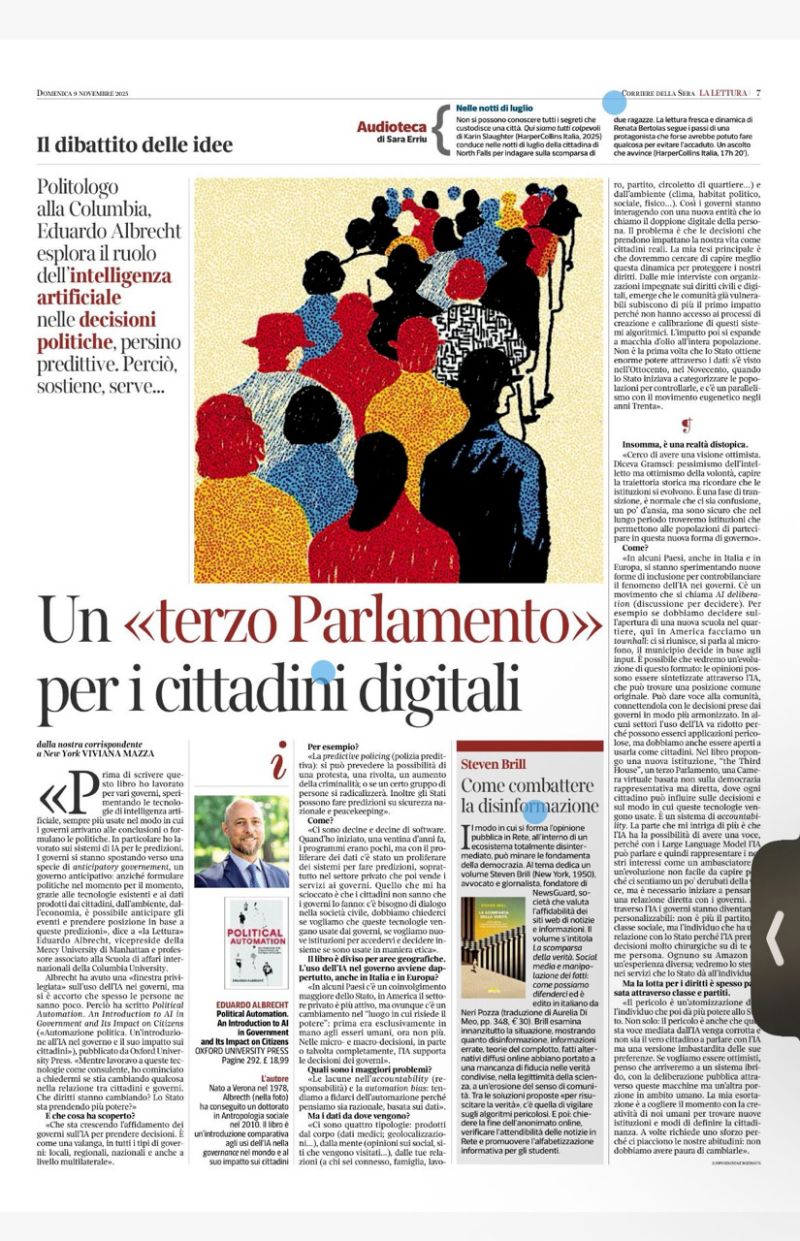
Interview, AI and the Future of Citizenship. Age of AI Podcast, October 19 2025
I joined the Age of AI podcast to explore how artificial intelligence is quietly transforming the way governments think, decide, and rule. From the rise of “political machines” to the idea of a new Third House of democracy, we unpack what happens when citizens become data—and how power itself is being rewritten in the age of automation.

Interview, Diplomacy, Data, and Decision-Making. What’s Working in Washington - May 8 2025
I sat down with the What’s Working in Washington podcast to explain how machines are reshaping how governments understand and interact with citizens.

AI Sees More Than You Think—Do We Need a Third House? Ignite Talks - Smart Ideas From Around the World - Betaworks, New York, April 4 2024
Governments don’t just watch where we go—they track our emotions, online lives, and even social connections. With AI making more public decisions, legacy institutions can’t keep up. In this talk, I argue for a radical idea: a “third house” of digital democracy, where citizen avatars represent us against government AI. Could our phones hold the key to future governance? Ignite Talks is a global speaker series and talk format.
Every Ignite Talk is exactly five minutes long, with twenty slides that auto-advance every fifteen seconds. The unique constraints require an increased level of creativity from the speaker and add an element of excitement for the audience. Ignite Talks events have been held in over 350 cities on six continents and have sparked tens of thousands of talks.

2025. “Does the United Nations Need Agents? Testing the role of AI agent generated personas in humanitarian action.” Working Paper, UNU CPR, New York.
This paper illustrates a case study with two AI agent generated persona systems, one called “Ask Amina” and the other “Ask Abdalla.” The first is designed to create an accurate digital representation of a refugee living in a camp in Chad. The second creates a digital replica of a combatant leader in the Rapid Support Forces (RSF), a group active in the southeastern part of Sudan from which many refugees are fleeing. Both systems combine digital avatars with large language models (LLMs), retrieval-augmented generation (RAG) and AI agent curated knowledge bases specifically designed to maximize the representativeness of each persona.
The effectiveness of Amina’s representation is measured by comparing “her” responses to survey questions against those provided by actual members of the refugee population. A sample of a negotiation with Abdalla, as well as a conversation between Amina and Abdalla, are qualitatively assessed. The experiment methodology and results are described in the case study section of this paper with further details in the appendix. Both personas can be experienced and tested at askamina.ai. Readers are invited to interact with either persona on any desired subject.
The primary objective of Ask Amina is to enable humanitarian and relief workers to ask questions about refugee experiences, needs, and sentiments, and receive responses that closely mirror real refugee perspectives. The objective of Ask Abdalla is to enable diplomats, and mediators to practice their skills with a persona that responds in ways consistent with a real combatant’s known behavioural patterns. The two personas are also put in conversation with each other as a preliminary test of a virtual AI-based community dialogue simulation.
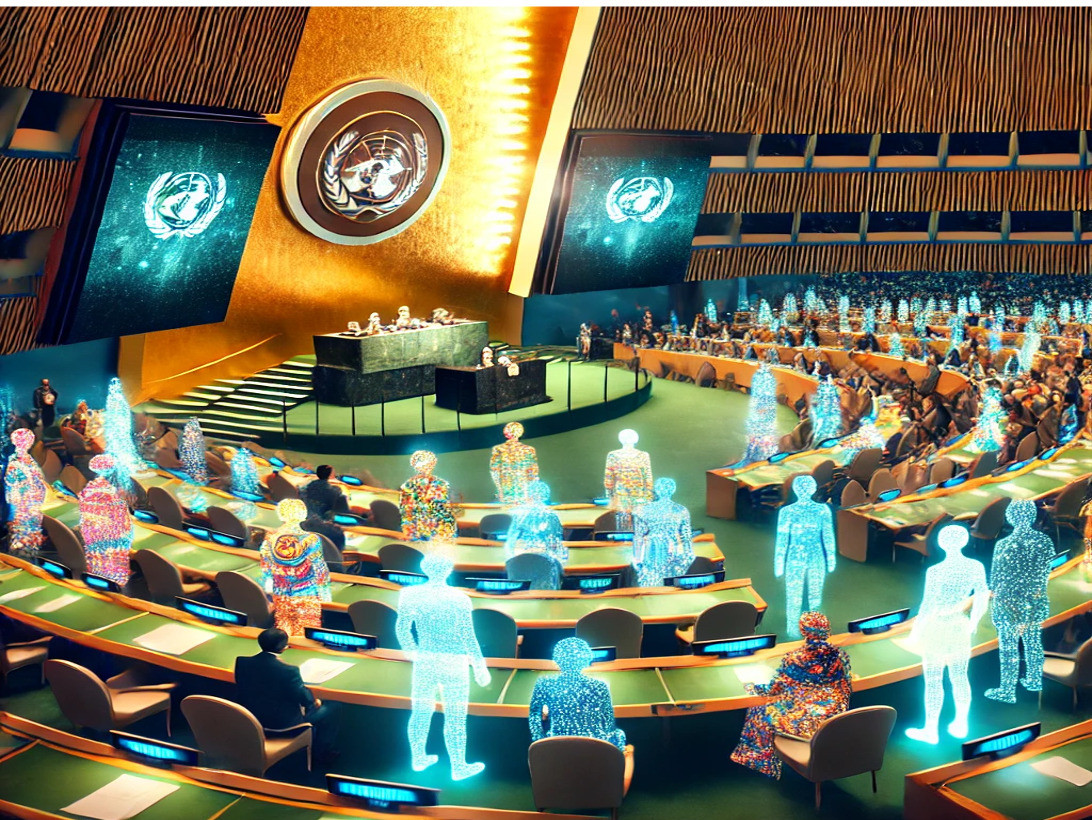
AI Agents in Global Governance: Digital Representation for Unheard Voices
Artificial intelligence is reshaping multilateral decision-making by giving voice to previously unheard stakeholders. Based on my recent book, Political Automation: An Introduction to AI in Government and Its Impact on Citizens (Oxford University Press, 2025), I argue that AI agents can help international organizations better incorporate marginalized communities into global governance frameworks.
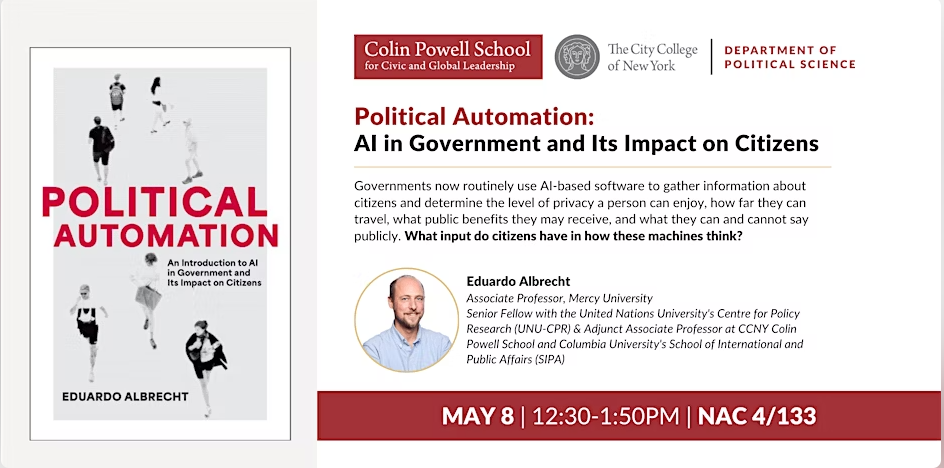
Political Automation Book Launch at Colin Powell School for Civic & Global Leadership
Governments now routinely use Al-based software to gather information about citizens and determine the level of privacy a person can enjoy, how far they can travel, what public benefits they may receive, and what they can and cannot say publicly. What input do citizens have in how these machines think?
Book your free tickets at the link below for the launch of Political Automation: AI in Government and its Impact on Citizens at the Colin Powell School for Civic & Global Leadership on Thursday, May 8 · 12:30 - 1:50pm EDT.

Reboot Democracy Blog - Branching Out: A Third Legislative Chamber for the AI Age
The proliferation and collection of large amounts of citizens’ data has led to the rise of "political machines" – AI systems used in government to make decisions around resource allocation. Political anthropologist Eduardo Albrecht argues that establishing a "Third House" – a new legislative body specifically designed to oversee the deployment and operation of political machines – could enable citizens to meaningfully engage with and oversee the AI tools used by their government.
Read the full blog here.

John Cabot University Interview - Political Automation: Alumnus Eduardo Albrecht Publishes New Book on AI
JCU alumnus Eduardo Albrecht (class of 1999, International Affairs and History) has recently published his new book, titled Political Automation: An Introduction to AI in Government and Its Impact on Citizens (Oxford University Press, 2025), which investigates the increasing governmental use of AI and theorizes the changing role of citizens in policy making.
Read the full interview here.